Assessing Two-Way Factorial Designs
2024-11-11
Announcements
- HW7 posted and due Friday Nov 15 11:59p
- Find a research article that uses ANOVA!
- Office hours
- Tuesday 10:30a - 11:30a
- Friday 3:00p - 4:00p
- Where to get HW7 help
- Spinelli center tutoring Sun-Thurs 7-9p, Sabin-Reed 301.
- Post questions to #hw7-questions channel on Slack!
- Direct message me on Slack.
Agenda
- Conditions for the Two-Way Factorial ANOVA
- Confidence intervals and effect sizes
Warm-up: Teaching Methods
A professor wanted to compare three different teaching methods to determine how students would perceive the course: 1) instructionist, 2) inquiry-based, and 3) team-based. She randomly assigned the same class (same topic different students) from 6 different semesters to treatments. At the end of the semester students were asked to rate the course on a 5-point scale, and the average class rating was calculated.
Warm-up: Swimsuit/Sweater Study
Objectification theory (Fredrickson & Roberts, 1997) posits that American culture socializes women to adopt observers’ perspectives on their physical selves. This self-objectification is hypothesized to (a) produce body shame, which in turn leads to restrained eating, and (b) consume attentional resources, which is manifested in diminished mental performance on a math test. An experiment manipulated self-objectification by having participants try on a swimsuit or a sweater. Further, it tested 20 women and 20 men, in each condition, and found that the effects on math performance were present for women only.
Warm-up: Anxiety and Memory
A psychologist wants to study the effect of anxiety on 4 different types of memory. Twelve participants are assigned to one of two anxiety conditions: 1) low anxiety group is told that they will be awarded $5 for participation and $10 if they remember sufficiently accurately, and 2) high anxiety group is told they will be awarded $5 for participation and $100 if they remember sufficiently accurately. All subjects perform four memory trials in random order, testing 4 different types of memory. The number of errors on each trial is recorded.
Three Research Questions, Three F-ratios
- Is there a significant main effect of factor A?
- Is there a significant main effect of factor B?
- Is there an significant interaction between factor A and factor B?
ANOVA Source Table for Two-Way Factorial
\[{y}_{ijk}={\mu}+{\alpha}_{i}+{\beta}_{j}+{\alpha\beta}_{ij}+{e}_{ijk}\]
| Source | SS | df | MS | F |
|---|---|---|---|---|
| Treatment A | \(\sum_{i=1}^{a}bn(\bar{y}_{i..}-\bar{y}_{…})^{2}\) | \(a-1\) | \(\frac{{SS}_{A}}{{df}_{A}}\) | \(\frac{{MS}_{A}}{{MS}_{E}}\) |
| Treatment B | \(\sum_{j=1}^{b}an(\bar{y}_{.j.}-\bar{y}_{…})^{2}\) | \(b-1\) | \(\frac{{SS}_{B}}{{df}_{B}}\) | \(\frac{{MS}_{B}}{{MS}_{E}}\) |
| Interaction AB | \(n\sum_{i=1}^{a}\sum_{j=1}^{b}(\bar{y}_{ij.}-\bar{y}_{i..}-\bar{y}_{.j.}+\bar{y}_{…})^{2}\) | \((a-1)(b-1)\) | \(\frac{{SS}_{AB}}{{df}_{AB}}\) | \(\frac{{MS}_{AB}}{{MS}_{E}}\) |
| Error | \(\sum_{i=1}^{a}\sum_{j=1}^{b}\sum_{k=1}^{n}({y}_{ijk}-\bar{y}_{ij.})^{2}\) | \(ab(n-1)\) | \(\frac{{SS}_{E}}{{df}_{E}}\) |
Confidence intervals and effect sizes
- If the interaction is significant
- Calculate CIs and effect sizes for sets of conditional averages (also called “simple effects”)
- For example, for the 0mg antibiotics condition, what’s the effect size for B12
- If the interaction is NOT significant
- Calculate CIs and effect sizes for sets of marginal averages (also called “main effects”)
- For example, what is the effect size for B12 overall?
Conditional Averages and Marginal Averages
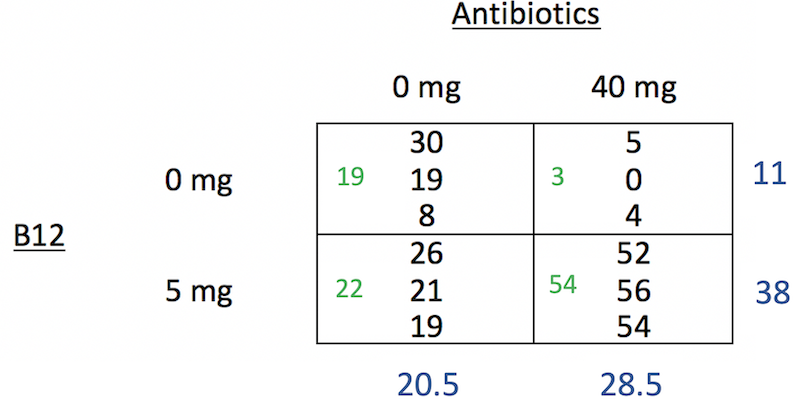
- The numbers in blue are Marginal Averages
- The numbers in green are Conditional Averages
Confidence Intervals and Effect Sizes
Confidence Intervals
\[(\bar{y_i}-\bar{y_j}) \pm t^*\cdot SD \sqrt{1/n_i+1/n_j}\]
Effect size
\[D_{ij} = \frac{(\bar{y_i}-\bar{y_j})}{SD}\]
- Where \(SD = \sqrt{MSE}\)